


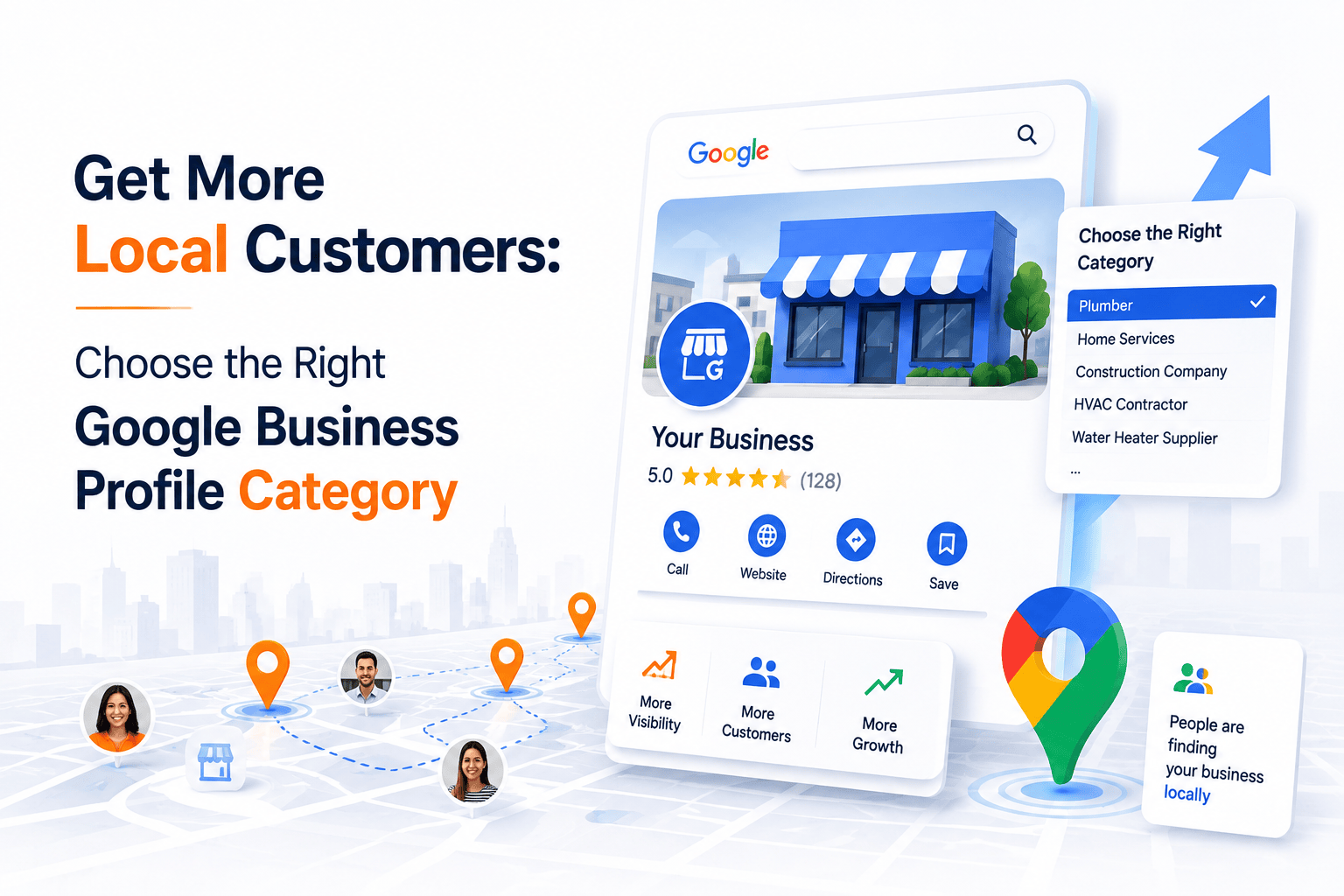
If your business relies on customers from a specific city or service area, your Google Business Profile can play an important role in how people discover you. But simply having a profile is not enough. The information inside that profile needs to accurately tell Google what your business does and which searches are relevant to you.
One of the most overlooked parts of a Google Business Profile is the business category. It may look like a small setting, but your category helps establish the context around your business and the services you provide.
Choosing the right category is not about adding as many keywords as possible. It is about selecting the category that most accurately represents your primary business activity and then supporting that choice with a strong website, relevant content, reviews and a complete local presence.
In this guide, we’ll look at how to choose the right category, how to research competitors and what you should do alongside your category selection to build a stronger local SEO foundation.
Key Takeaways
✓
Your primary category should accurately describe the main service or activity of your business.
✓
Secondary categories should be relevant to genuine services you provide.
✓
Competitor research can help identify patterns in your local market.
✓
Your category is only one part of a broader local SEO strategy.
✓
Your website should reinforce the same services and business focus shown in your profile.
✓
Review your profile whenever your business services or focus changes.
In This Article
A Strong Local Presence Starts With Relevance
Your Google Business Profile, website and SEO strategy should all communicate the same business focus.
01Relevant
Choose a category that genuinely represents your core business.
02Focused
Use additional categories only when they describe real services.
03Consistent
Keep your profile, website and business information aligned.
04Local
Build authority and relevance around the locations you actually serve.
1. Why Your Google Business Profile Category Matters
Think of your primary category as a concise description of what your business actually is. It is not a slogan, a list of keywords or a place to mention every service you offer.
When someone searches for a local business, Google needs to understand what type of business is relevant to that search. Your category is one of the signals that helps establish that context.
For example, if a company primarily provides professional plumbing services, selecting a category that accurately describes plumbing is more useful than choosing a vague category simply because it sounds broader.
Local SEO involves much more than one profile setting. Relevance, location, reviews, website quality, business information and other signals all contribute to the overall picture. Your category should therefore be viewed as part of the foundation, not a shortcut to rankings.
2. Primary vs. Secondary Categories
Google Business Profiles allow businesses to select a primary category and additional categories. Understanding the difference can help you keep your profile focused and accurate.
Primary Category
Your primary category should describe the main business activity customers associate with your company. If you had to describe your business using only one category, this is the category you would choose.
Secondary Categories
Secondary categories can provide additional context when your business genuinely offers related services. They should represent meaningful parts of your business rather than being added simply because they contain useful search terms.
Keep Your Categories Relevant
The strongest profile is not necessarily the one with the most categories. It is the one that accurately represents the business.
01
Primary Category
Choose the category that best describes the main reason customers hire you.
02
Secondary Categories
Add related categories only when they accurately describe genuine services or activities.
03
Customer Intent
Think about how your customers describe the service when they are ready to find a local provider.
3. How to Choose the Right Google Business Profile Category
There is no universal category that is right for every business. The best choice depends on what you actually provide and how customers understand your business.
Start With Your Main Service
Ask a simple question: What do customers primarily hire us to do? Look at your main service, your website navigation, customer enquiries and the services that represent the biggest part of your business.
Use Google's Available Categories
Google uses predefined categories. Review the available options carefully and select the closest legitimate match rather than attempting to create your own category through keywords.
Think Like Your Customer
Your internal terminology may not be the same terminology customers use. Consider what a potential customer would type or select when looking for the service you provide locally.
Match the Category to the Business
If the category does not accurately describe your business, do not select it simply because you believe it could attract more traffic. Local SEO works best when search visibility and customer expectations match.
4. Research Businesses That Already Perform Well Locally
Competitor research can help you understand how Google is interpreting businesses in your market. Start by searching for your most important service combined with the city, suburb or service area you target.
Look at several businesses that consistently appear in local results rather than focusing on only one competitor. Compare their categories, services, reviews, website structure, location information and the way they describe their business.
The objective is not to copy another business. Instead, look for patterns. If several strong local businesses use similar categories, that can provide useful context when evaluating your own category choice.
Third-party tools may provide additional information for competitor research, but category choices should always be checked against the current Google Business Profile interface before making changes.
5. When Should You Use Secondary Categories?
Secondary categories can be useful when your business provides multiple closely related services. They help provide additional context without changing the main identity of the business.
For example, a business may have one core service while also offering another closely related service that customers regularly search for. In that situation, a relevant secondary category may make sense.
The key is to keep everything relevant. Adding unrelated categories just because they contain popular keywords can make the profile less representative of the actual business.
Your categories should also complement your website. If you offer several important services, create useful dedicated pages that explain those services instead of relying on profile categories alone.
Common Google Business Profile Category Mistakes
A few common mistakes can weaken the accuracy and usefulness of a local business profile.
01
Choosing the Broadest Category
A broad category does not automatically give you better visibility. Accuracy is more important than simply selecting a larger-sounding business type.
02
Adding Categories for Keywords
Do not select unrelated categories simply because you want to appear for a particular search term.
03
Copying a Competitor
A competitor's category may be right for their business but not necessarily right for yours.
04
Forgetting Business Changes
Your business may evolve. If your main service changes, review whether your category still accurately represents what you do.
05
Ignoring the Website
A category cannot replace useful website content, strong service pages, good technical SEO and a clear customer journey.
6. What Should You Do After Updating Your Category?
Do not expect one profile change to transform your local search performance overnight. Local visibility is influenced by multiple signals, and search results can change for many reasons.
Instead, treat the category update as part of a broader optimisation process. Make sure your business information is accurate, your services are clearly explained and your website provides useful information for people who are considering contacting you.
Then monitor meaningful outcomes over time. Depending on your business, these may include website visits, calls, direction requests, enquiries or other profile interactions.
Looking at trends over time is more useful than judging the impact from a single day or a single ranking position.
7. Make Your Website Support Your Local Search Strategy
Your Google Business Profile and your website should tell the same story. If your profile clearly communicates one service but your website is vague, outdated or difficult to navigate, an important part of the customer journey is missing.
Create dedicated service pages for important offerings, use descriptive headings, answer customer questions and make your contact options easy to find. Your website should give both visitors and search engines a clear understanding of what your business provides.
A strong website design also helps create a better first impression after someone discovers your business through Google.
If your website needs a stronger technical foundation, our web development services can help improve performance, scalability and functionality while supporting your wider digital strategy.
8. Build the Rest of Your Local SEO Foundation
Choosing the right category is important, but it is only one part of local search optimisation. A complete strategy should look at the entire customer journey from discovery to conversion.
- Keep your business information accurate and consistent
- Build a useful, mobile-friendly website
- Create dedicated pages for important services and locations
- Publish genuinely useful content that answers customer questions
- Encourage genuine customer reviews and respond professionally
- Improve website speed and technical performance
- Use clear internal links between relevant service and information pages
- Monitor search visibility, website traffic and customer enquiries
- Review your local SEO strategy as your business changes
Our SEO services can help bring these areas together into a focused search strategy built around your business goals.
Local SEO Category Checklist
Before considering your Google Business Profile category work complete, review the following:
- Your primary category accurately describes your main business activity
- You have reviewed Google's available category options
- You have compared several relevant local competitors
- Secondary categories represent genuine services or business activities
- Your business name, address and contact information are accurate
- Your website clearly explains your core services
- Your important service pages are internally linked
- Your website works well on mobile devices
- Your customers have clear ways to contact or enquire with you
- You have a process for reviewing your profile when the business changes
Frequently Asked Questions
Does the Google Business Profile category affect local SEO?
Your category helps Google understand what type of business you operate and whether your profile is relevant to particular local searches. It is one part of a broader local SEO strategy.
Should I add as many secondary categories as possible?
No. Secondary categories should accurately describe meaningful parts of your business. Adding unrelated categories simply to target additional searches is not a good approach.
Can I change my Google Business Profile category?
Businesses can review and update their profile information as their business changes. After making an update, monitor your overall performance rather than expecting an immediate ranking change.
Is changing my category enough to improve rankings?
Usually not. Category selection should work alongside relevant website content, reviews, accurate business information, technical SEO and a strong overall local presence.
Final Thoughts
Your Google Business Profile category may look like a small setting, but it helps establish how Google understands your business. Choosing a category that accurately reflects your main service gives your profile a stronger foundation for local search.
The important thing is not to treat category selection as a ranking shortcut. The strongest local presence comes from several pieces working together: an accurate profile, useful website content, strong customer reviews, relevant service pages, technical performance and a consistent customer experience.
If you have not reviewed your category recently, it is worth taking a closer look. Compare it with relevant businesses in your local market and, most importantly, make sure it still reflects what customers actually hire you to do.
At InSpring Design, we combine website design, web development and SEO to help businesses build a stronger digital presence that works for both search engines and real customers.
GROW YOUR LOCAL PRESENCE
Want more customers to find your business online?
Let's build a stronger local search presence with the right website, SEO strategy and digital experience.
Start a ProjectStart a Project→